Introduction:
Online betting and slot websites have grown rapidly, but not all of them operate legally. The goal of this article is purely educational—to help readers understand how licensing works, how to verify it, and how to stay safe online.
This guide does not encourage gambling. Instead, it explains the rules, risks, and legal considerations involved so people can make informed and responsible decisions.
Table of Contents
Why Licensing Matters
A proper gambling license means the website is supervised by an official authority. Regulators set rules to ensure fair play, protect users’ money, and prevent fraud.
Unlicensed websites often operate secretly, offering no protection if something goes wrong.
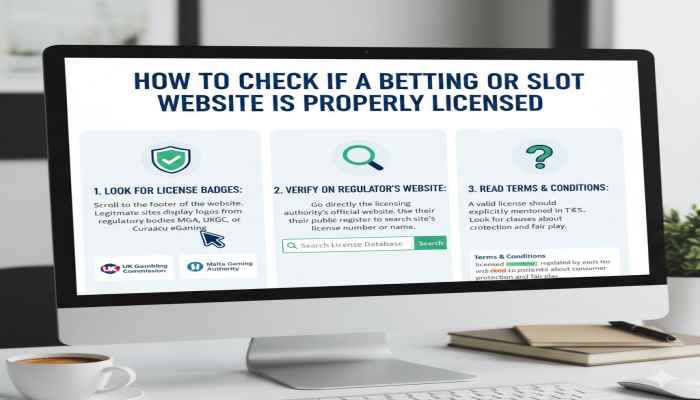
How to Check if a Betting or Slot Website Is Properly Licensed
1. Look for the Licensing Seal on the Website
Most legal operators place their license information at the bottom of the homepage.
This section may include:
- The name of the licensing authority
- A license number
- A verification link
Common regulators include:
- UK Gambling Commission (UKGC)
- Malta Gaming Authority (MGA)
- Gibraltar Gaming Commissioner
- Isle of Man Gambling Supervision Commission
- Curacao eGaming
2. Verify the License Number on the Official Regulator Website
A website may claim to be licensed, but verification is essential.
You can visit the regulator’s website and:
- Search by license number
- Search by company name
- Check if the license is active, suspended, or expired
If the information does not match, it is a warning sign.
3. Check the Domain Security (HTTPS)
A licensed site will always use HTTPS, not HTTP.
This protects personal information and payment details.
A missing security certificate is a major red flag.
4. Review the Website’s Terms and Conditions
A legal operator clearly displays:
- Age requirements (18+ or country-specific)
- Rules of use
- Withdrawal rules
- Complaint handling procedures
Unclear or missing terms often signal an unregulated site.
5. Look for Responsible Gambling Tools
Licensed sites offer tools for safer play, such as:
- Deposit limits
- Self-exclusion
- Reality checks
Illegal or unlicensed websites rarely provide these options.
Risks of Using an Unlicensed Betting or Slot Website
1. Fraud and Theft
Unlicensed websites can disappear with users’ money, and there is no authority to report to.
2. Unfair or Manipulated Games
Without regulation, game results may be tampered with, giving users no real chance of fairness.
3. No Customer Protection
Licensed operators must follow strict rules. Unlicensed ones do not, leaving users completely unprotected.
4. Data Privacy Risks
Personal information can be misused or sold without permission.
Legal Considerations in Different Regions
Online gambling laws vary by country or region:
United Kingdom
Only websites licensed by the UKGC can legally operate.
European Union
Rules vary, but many countries require domestic or EU-approved licenses.
United States
Regulations depend on individual states. Some states allow online betting, others do not.
Also Chack: Responsible Gambling: How to Set Limits and Protect Yourself Online
Asia & Other Regions
Many countries have strict bans or limitations. Users should always research local laws before accessing gambling websites.
Responsible Gambling Reminder (18+)
- Online gambling is strictly for 18+ or the legal age in your location.
- If you choose to participate in gambling activities, do so responsibly and within limits.
- Seek help if you feel gambling is affecting your mental, financial, or personal life.
Support organizations include: - GamCare
- Gambling Therapy
- National Helpline (country-specific)
Conclusion
Checking whether a betting or slot website is properly licensed is an essential safety step.
This article provided an educational overview of how to verify licenses, understand regulatory bodies, identify risks, and follow responsible gambling principles.
Staying informed is the best way to protect yourself online.
Frequently Asked Questions (FAQs)
1. Where can I find a website’s gambling license?
Usually at the bottom of the homepage, in the footer.
2. Is a Curacao license legitimate?
Yes, it is a recognized regulator, but it offers lighter oversight than regulators like the UKGC or MGA.
3. Can an unlicensed website still look professional?
Yes. Scammers often design attractive sites, so verification is essential.
4. Why should I verify the license number manually?
Because some sites display fake badges or unverifiable numbers.
5. Is it legal to use licensed websites in any country?
No. Legality depends on local laws, which vary worldwide.