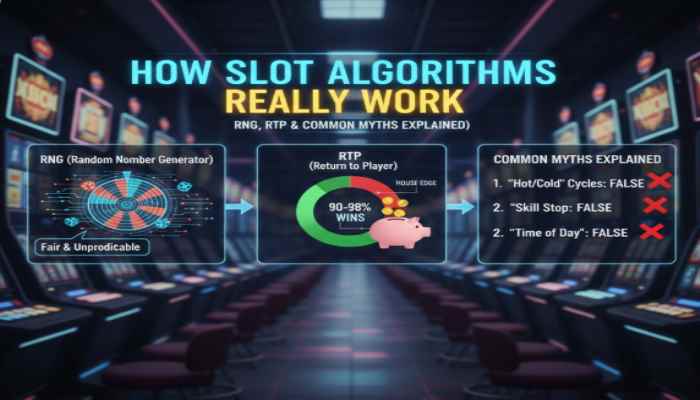
Introduction:
This article is written strictly for educational purposes. Its goal is to explain how slot machine algorithms work, what terms like RTP (Return to Player) and RNG (Random Number Generator) really mean, and to clear up common myths.
It does not promote gambling or encourage anyone to play. Instead, it highlights risks, legal considerations, and responsible gambling guidelines for adults (18+).
Table of Contents
How Slot Algorithms Work: The Basics
1. What Is an RNG? (Random Number Generator)
At the core of every modern slot machine—both online and offline—is an RNG, a mathematical program that constantly creates random numbers.
- The RNG runs 24/7, even when no one is playing.
- Every spin result is based on the exact millisecond the button is clicked.
- RNG ensures each spin is independent and does not “remember” previous results.
Key point:
No player, website, or strategy can predict or “control” an RNG spin.
2. What Is RTP? (Return to Player)
RTP is a theoretical percentage showing how much of the total wagered money a slot may return to players over a long period.
Example:
A slot with 96% RTP theoretically returns $96 out of every $100 wagered—but spread across thousands or millions of spins, not individual players.
Important facts:
- RTP is calculated over long-term statistical tests.
- Short-term results can be very unpredictable.
- RTP does not guarantee any player a specific outcome.
3. Volatility and Hit Frequency
Slot algorithms also include factors that affect how the game feels:
- Low volatility: Frequent but smaller wins
- High volatility: Rare but larger wins
- Hit frequency: How often a winning combination might appear
These features shape the gaming experience but do not change the randomness of each spin.
Also Chack: The Psychology of Gambling Addiction & Early Help Guide 2025
Common Myths About Slot Algorithms (Debunked)
Myth 1: “Slots pay more at night.”
False. RNG does not consider time, number of players, or casino activity.
Myth 2: “Machines get hot or cold.”
No. Each spin is independent—previous outcomes have no influence.
Myth 3: “Betting more increases your chance of winning.”
Not true. Wager size does not change the RNG sequence.
Myth 4: “Online casinos can force losses.”
Licensed operators are required to use certified, audited RNG software. Manipulating results would violate gaming laws and lead to license loss.
Risks and Disadvantages to Be Aware Of
Even with transparent algorithms, slot-style games come with real risks:
- High potential for financial loss
- Fast-paced gameplay may increase overspending
- No strategy or system can guarantee profit
- Entertainment value can lead to addictive patterns
- Chasing losses increases harm
Understanding these risks is essential for maintaining safe behavior.
Legal Considerations in Different Regions
Laws about online slots vary widely depending on country or region. Examples:
1. Europe
Many European countries regulate online gaming through national authorities (e.g., UKGC, MGA). Operators must follow strict rules for fairness, transparency, and advertising.
2. United States
Laws differ by state. Some states allow licensed online gambling; others prohibit it entirely.
3. Asia & Middle East
Many regions impose strict restrictions or complete bans on online gambling websites.
4. South Asia
Regulations can vary, and many areas have unclear or evolving policies.
Important reminder:
Always check local laws before engaging with any gaming platform. Accessing unlicensed websites increases the risk of fraud, identity theft, or financial loss.
Responsible Gambling Tips (18+ Only)
If someone chooses to engage with gambling activities, they should follow responsible guidelines:
- Only adults 18+ (or legal age in your region) should participate.
- Set strict financial and time limits.
- Treat slot games as entertainment, not as a way to make money.
- Never chase losses.
- Take regular breaks to avoid impulsive behavior.
- Seek help from professional organizations if gambling becomes difficult to control.
Responsible gambling tools—such as deposit limits, self-exclusion, and activity monitoring—can also offer additional protection.
Conclusion
Slot machines operate through mathematical algorithms, mainly RNG and RTP, which determine outcomes in a controlled and regulated way. Understanding these systems helps debunk myths and highlights the importance of caution, legality, and responsible behavior.
This article aims to provide pure educational value, helping readers stay informed and safe online.
Related FAQs
1. Can players predict slot outcomes?
No. RNG technology ensures every spin is unpredictable and independent.
2. Are higher RTP slots guaranteed to pay more?
Not to individual players. RTP is a long-term statistical measure, not a prediction.
3. Do online casinos control when a slot pays out?
Licensed operators cannot legally manipulate outcomes; certified RNGs ensure fairness.
4. Why do some slots feel like they “almost win”?
This is due to intentional game design and volatility—not manipulation.
5. Is it safer to use licensed gaming websites?
Yes. Licensed platforms are required to follow strict rules, audits, and consumer protection standards.